Sleep and Circadian Effects on Fat Partitioning
Exploring how sleep duration, quality, and circadian rhythm disruption influence metabolic regulation and abdominal adiposity.
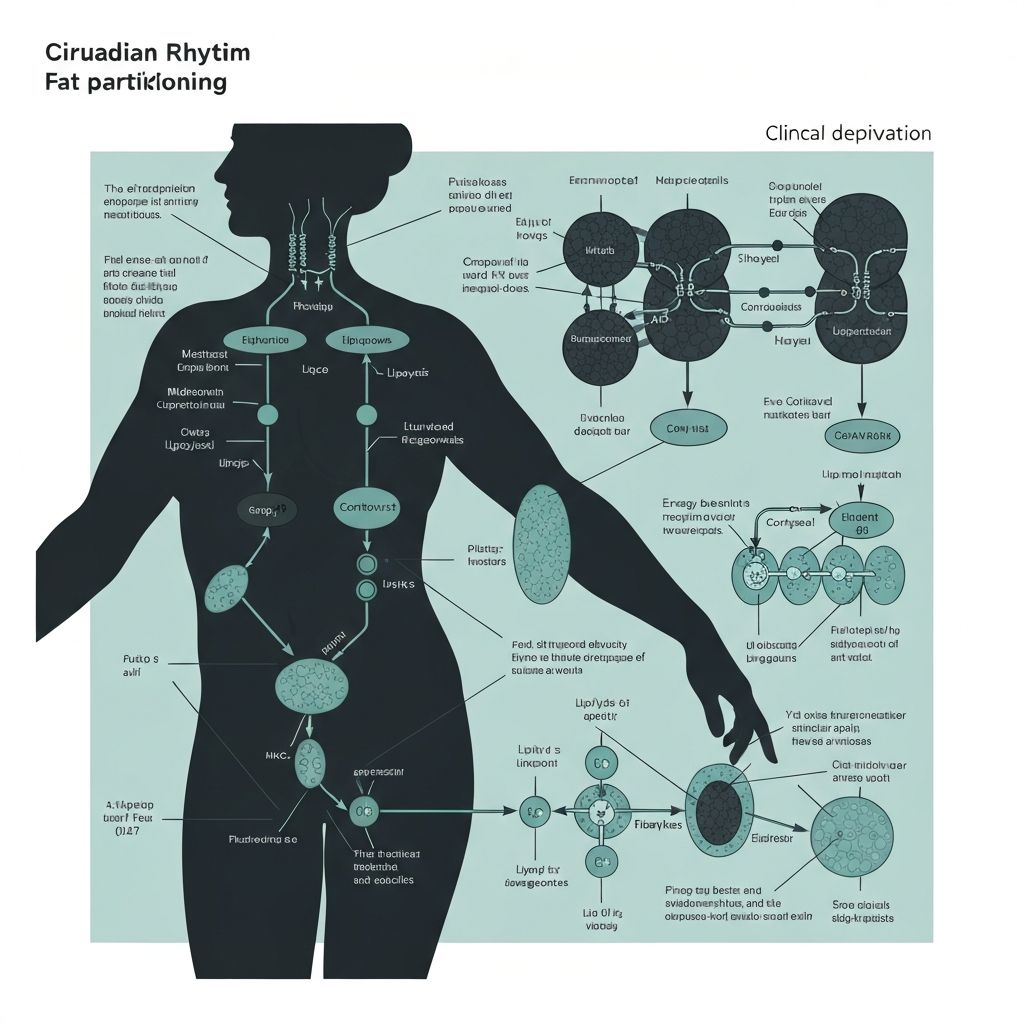
Sleep Duration and Central Adiposity
Large-scale epidemiological studies consistently demonstrate robust associations between short sleep duration and increased central adiposity, elevated waist circumference, and higher visceral fat volume. These associations persist across diverse demographic groups, geographic regions, and study designs, suggesting a robust and generalizable relationship.
Cross-sectional studies show that individuals sleeping fewer than 6-7 hours nightly demonstrate significantly higher waist circumference and visceral adiposity compared to those sleeping 7-8 hours despite similar caloric intake estimates. Longitudinal studies tracking individuals over years document that short sleep duration associates with greater visceral fat accumulation over time.
Importantly, the relationship between sleep duration and central adiposity appears to be independent of total body weight changes, suggesting that sleep specifically influences fat distribution patterns rather than obesity per se.
Sleep Deprivation Effects on Metabolic Hormones
Sleep deprivation produces acute changes in hormones regulating appetite and metabolism:
- Ghrelin elevation - the "hunger hormone" increases with sleep deprivation, promoting appetite and food-seeking behavior
- Leptin suppression - the satiety hormone decreases with insufficient sleep, reducing fullness signaling
- Cortisol dysregulation - sleep loss impairs normal diurnal cortisol rhythms, producing elevated evening cortisol
- Insulin resistance - acute sleep deprivation reduces insulin sensitivity within hours
This hormonal milieu—elevated appetite signaling combined with reduced satiety and impaired metabolic regulation—creates metabolic circumstances particularly favorable to preferential central fat accumulation.
Sleep Quality and Metabolic Dysfunction
Beyond sleep duration, sleep quality significantly influences metabolic health. Sleep fragmentation (repeated brief awakenings), reduced slow-wave sleep (deep, restorative sleep), and obstructive sleep apnea all associate with metabolic dysfunction and central adiposity.
Patients with obstructive sleep apnea (OSA), characterized by recurrent breathing interruptions and arousal events throughout sleep, demonstrate elevated central adiposity and insulin resistance beyond what body weight alone would predict. The intermittent hypoxia (oxygen deprivation) and sympathetic nervous system activation characteristic of OSA directly promote visceral fat accumulation and metabolic dysfunction.
Circadian Rhythm Disruption and Metabolic Effects
Beyond sleep duration and quality, circadian rhythm disruption—misalignment between internal circadian timing and external environmental timing—profoundly influences fat distribution. Modern schedules frequently conflict with circadian optimal patterns through shift work, irregular sleep schedules, and exposure to evening artificial light.
Circadian rhythms regulate numerous metabolic processes including glucose metabolism, insulin secretion, lipid metabolism, and energy expenditure. Disruption of these rhythms impairs metabolic regulation across all systems. Studies of shift workers document consistently elevated visceral adiposity and metabolic dysfunction compared to day-working controls, suggesting that circadian disruption per se promotes central fat accumulation.
Temporal Nutrient Distribution and Fat Partitioning
Circadian rhythms regulate the metabolic fate of dietary nutrients. Carbohydrate metabolism and glucose tolerance demonstrate circadian variation, with better glucose handling in morning hours compared to evening. Evening eating, particularly of refined carbohydrates, produces more pronounced hyperinsulinaemia and postprandial glycemic excursions.
The combination of circadian-optimal substrate partitioning in morning hours and circadian-impaired metabolism in evening hours suggests that meal timing relative to circadian phase influences fat storage distribution. Eating patterns misaligned with circadian phase—such as heavy evening meals in shift workers—may preferentially promote visceral fat accumulation through circadian-metabolic interactions.
Activity and Exercise Timing
Physical activity timing relative to circadian phase influences metabolic outcomes. Morning exercise demonstrates metabolic advantages compared to evening activity, including better glucose tolerance and insulin sensitivity improvements. Circadian disruption from irregular sleep schedules often accompanies reduced total physical activity, compounding metabolic effects.
Sympathetic Nervous System Activation
Sleep deprivation and circadian disruption both elevate sympathetic nervous system tone, producing sustained low-level sympathetic activation. While acute sympathetic activation promotes fat mobilization, chronic elevated sympathetic tone paradoxically associates with fat accumulation and promotes preferential visceral fat deposition.
The mechanism involves sympathetic activation's effects on adipocyte metabolism, substrate partitioning, and visceral-specific adipocyte function. Chronic stress (sympathetic activation) preferentially promotes visceral fat storage despite mobilizing subcutaneous reserves acutely.
Research on Sleep Intervention and Central Adiposity
Intervention studies examining sleep improvement demonstrate that extending sleep duration in chronic sleep-restricted individuals produces improvements in insulin sensitivity and reduces appetite hormone dysregulation. Some studies document improvements in waist circumference and adiposity measures with sleep extension, though the magnitude of changes varies substantially.
These intervention findings support a causal relationship where sleep deprivation promotes central adiposity and improved sleep allows more normal metabolic regulation. However, individual responses vary substantially, and sleep improvement does not uniformly eliminate established central adiposity.
Restoration of Circadian Alignment
Interventions promoting circadian rhythm alignment—including consistent sleep timing, morning light exposure, and evening darkness—have demonstrated improvements in metabolic markers in controlled studies. However, real-world challenges to circadian alignment (occupational demands, social schedules, modern technology use) often limit individuals' ability to achieve optimal circadian phase.
Interaction with Other Metabolic Factors
Sleep and circadian disruption do not act in isolation on fat distribution. Sleep loss impairs glucose tolerance and produces insulin resistance, both promoting central fat accumulation through mechanisms discussed in our insulin-focused article. Sleep deprivation elevates cortisol, promoting cortisol-mediated central fat storage through glucocorticoid mechanisms.
Additionally, poor sleep frequently accompanies elevated perceived stress, mood dysregulation, and reduced physical activity—all factors independently promoting visceral adiposity. Distinguishing the independent effects of sleep disruption from these correlated factors remains a research challenge.
Educational Note
This article explains associations between sleep, circadian rhythm, and abdominal adiposity based on research findings. Individual sleep needs and circadian preferences vary substantially. This information is educational only and does not constitute sleep or medical recommendations. Individuals with sleep concerns should consult qualified healthcare professionals.